by ajblake
on June 2, 2016
{ }

Snipe Fly - ♀
Rhagio sp., Rhagionidae
Cogburn Beach, Harrison Lake, British Columbia, Canada
Nikon D5100, 105 mm f/2.8
May 21, 2016
I found this striking lady while wondering around our campsite on Harrison Lake this past May long weekend. Despite the loud music and let’s say “eccentric” fellow campers, the area was beautiful and full of nature.
by ajblake
on May 26, 2016
{ }
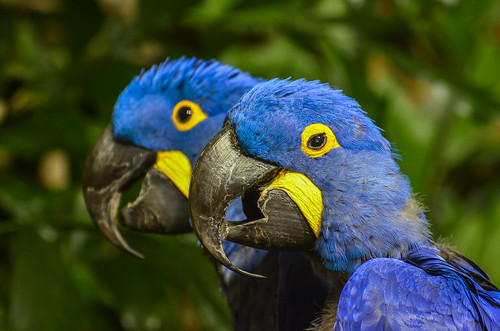
Hyacinth Macaw
Anodorhynchus hyacinthinus, Psittacidae
Vancouver Aquarium, Vancouver, British Columbia, Canada
Nikon D5100, 70-300 mm f/4.5-5.6
May 15, 2016
Sara and I visited the aquarium a few weeks back along with her parents. As a change of pace I decided to bring my telephoto rather than my fast prime. While I wasn’t able to get any really good shots inside because of the low light, I was able to get some satisfying close ups (like the one above) on the marine mammals outside and the birds in the Amazon Gallery. I have a full set of photos from the aquarium over at flickr.
by ajblake
on May 18, 2016
{ }

Blue-eyed Darner
Rhionaeschna multicolor, Aeshnidae
Maplewood Conservation Area, North Vancouver, British Columbia, Canada
Nikon D5100, 70-300 mm f/4.5-5.6
May 7, 2016
This week we have yet another pair of mating dragonflies. The male is above grasping the female just behind her eyes with his claspers. The female is below curling her abdomen up to the base of the male’s thorax where his secondary genitalia are located.
by ajblake
on May 11, 2016
{ }

Western Tiger Beetle
Cicindela oregona oregona, Carabidae
Iona Beach Regional Park, Richmond, British Columbia, Canada
Nikon D5100, 105 mm f/2.8
May 1, 2016
Here we have a shot of our locally common Tiger Beetle. Tiger beetles are an awesome subfamily of Carabids adapted to run down prey across stretches of unvegetated ground. They are actually able to run so fast relative to their body size that they have to use a
stop and go running style to allow them to accurately track their prey. The post title is a reference to the great book
Tiger Beetles of Alberta by John Acorn.
by ajblake
on May 6, 2016
{ }
After a bunch fiddling with plugin settings and CSS, I’m ready to unveil my new justified design for my photo galleries. Before you give me too much credit, the actual layout is all generated by the Flickr Justified Gallery plugin. I’m really happy with these new galleries look and how they make efficient use of the available space. [click to continue…]
by ajblake
on May 3, 2016
{ }

Immature Common Green Darner
Anax junius, Aeshnidae
Minnekhada Regional Park, Coquitlam, British Columbia, Canada
Nikon D5100, 70-300 mm f/4.5-5.6
May 31, 2015
Unlike most of the dragonfly fauna of BC which stay put all year round, Green Darners are migratory. Like Monarchs, adults migrate north in the spring and it is their offspring, who emerge in late summer, that migrate back south. You can help conserve migratory dragonflies by report sightings to the Migratory Dragonfly Partnership.
by ajblake
on April 29, 2016
{ }

Spotted Jelly
Mastigias papua, Mastigiidae
Vancouver Aquarium, Vancouver, British Columbia, Canada
Nikon D5100, 35 mm f/1.8
May 30, 2015
This week’s photo features some not so spotty Jellies from the Vancouver aquarium. I really like the creamy bokeh in this shot.
by ajblake
on April 18, 2016
{ }

Western Goat's Beard
Tragopogon dubius, Asteraceae
Iona Beach Regional Park, Richmond, British Columbia, Canada
Nikon D5100, 70-300 mm f/4.5-5.6
May 23, 2015
Like Dandelion with which is sometimes confused, Western Goat’s Beard is another member of the daisy family (Asteraceae). It can be easily distinguished from Dandelion by it’s longer involucre bracts (leafy bits just below the flowers) which extend beyond the flowers. Both species lack the central disk flowers of their more daisy like relatives and their flowering heads consist only of ray flowers. I really like this shot because you can clearly see the bilobed stigma (♀ bits) and fused anther cylinders (♂ bits) that are characteristic of the Asteraceae.
by ajblake
on April 14, 2016
{ }

New Dress
Cameron Park, Burnaby, British Columbia, Canada
Nikon D5100, 35 mm f/1.8
April 13, 2016
Sara just finished her latest sewing project and enlisted my help in showing off her new dress. For those in the know: Butterick 4790.
by ajblake
on March 25, 2016
{ }
You might be wondering where Figure 1 was taken and what it has to do with polarized light. The picture shows an unfortunate water boatman that landed on the roof of my car and quickly succumbed to the high temperatures of the sun baked metal. Why would this aquatic insect be landing on a car in the first place? The answer has to do with polarized light. [click to continue…]


Find Me On